
ISO Standards. Real Impact.
ISO 42001 Certification in Pittsburgh
Responsible AI. Stronger Governance. Greater Trust.
- IAS Accredited
- Independent Certification Body
- International Recognition
Your Certificate, Independently Verifiable
Every ISO/IEC 42001 certificate GMSQUEST issues is accredited by IAS and listed on the IAF CertSearch global register, where your customers can confirm it themselves.
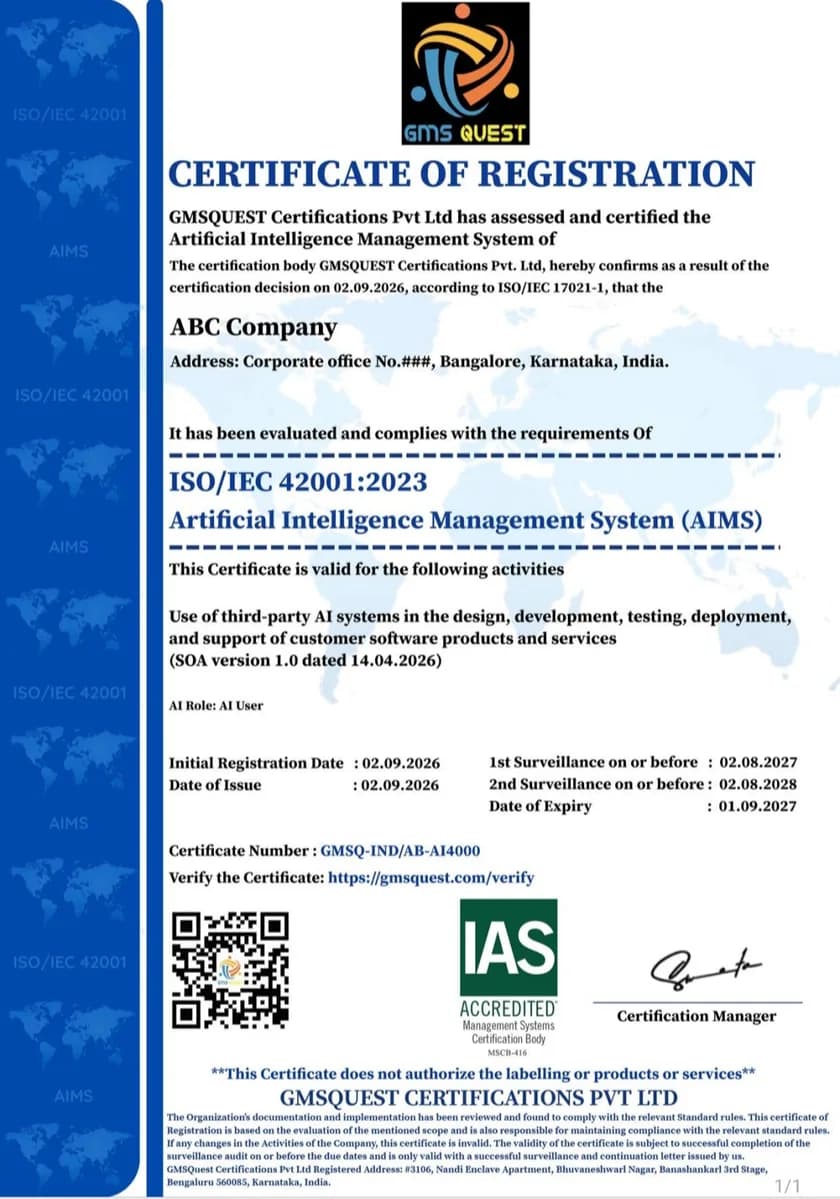
Sample certificate
What a GMSQUEST ISO/IEC 42001 certificate of registration looks like, including the IAS accreditation mark, the certificate number and the QR code that links to its record.
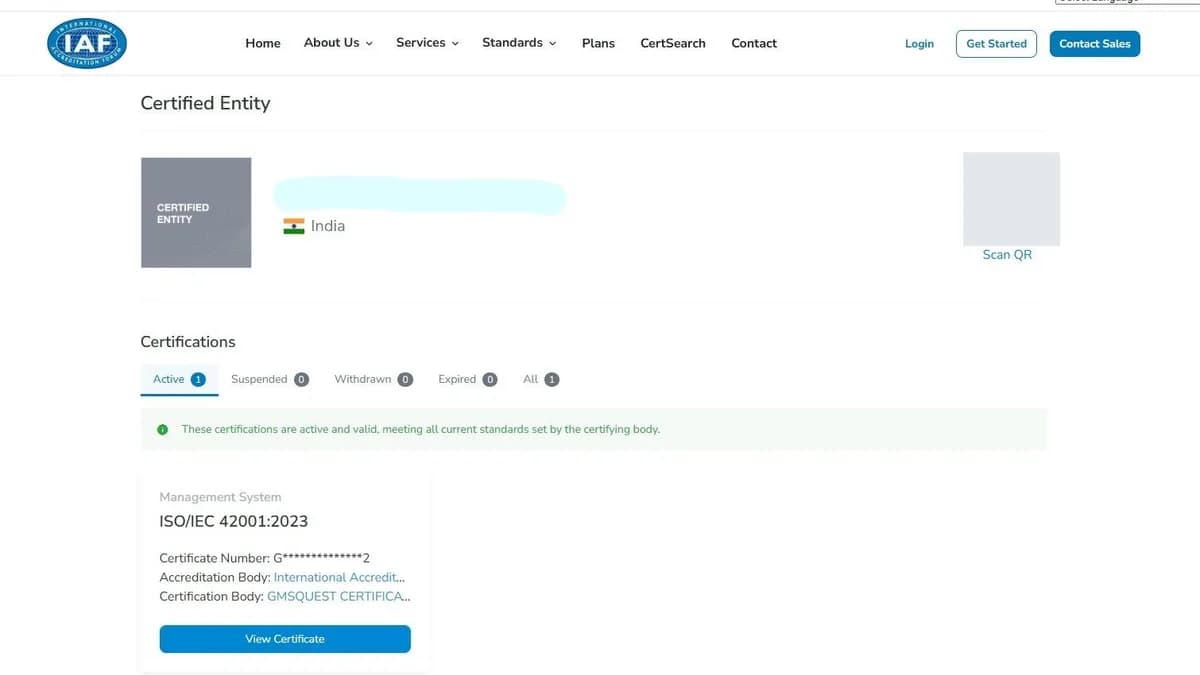
Listed on IAF CertSearch
GMSQUEST certificates appear on the International Accreditation Forum's global register. Anyone can search it and see the standard, the accreditation body and whether a certificate is active — without taking our word for it.
What is ISO 42001?
ISO/IEC 42001:2023 is an international management system standard specifically designed for organizations that develop, provide, or use artificial intelligence systems.
It establishes a systematic framework for managing AI-related governance, risks, impacts, processes, and responsibilities.
ISO/IEC 42001 can help organizations establish structured AI governance and demonstrate that their AI-related activities are managed through a defined and continually improving management system.

Why ISO 42001 Matters
AI introduces opportunities as well as specific governance, operational, ethical, and risk-management considerations. A management system approach helps organizations move from isolated AI controls and policies toward a structured framework with defined processes, responsibilities, objectives, monitoring, and continual improvement.
- Structured AI GovernanceEstablish processes, oversight, and responsibilities for managing AI-related activities.
- AI Risk & Impact ManagementCreate a systematic approach to identifying, assessing, and addressing AI-related risks and impacts.
- Transparency & AccountabilityDefine roles, policies, and management processes that support accountability for AI systems.
- Independent Conformity AssessmentCertification provides an external assessment of an AIMS against applicable ISO/IEC 42001 requirements.
- Stakeholder ConfidenceAn internationally recognized management system standard can help communicate an organization's structured approach to AI management.
What ISO 42001 Certification Delivers
An implemented Artificial Intelligence Management System can provide a structured basis for:
- AI governance policies and objectives
- Defined responsibilities and accountability
- AI risk and impact assessment processes
- Management oversight and operational controls
- Monitoring, corrective action, and continual improvement
- Demonstration of conformity with ISO/IEC 42001
ISO 42001 Certification for Pittsburgh Organizations
Pittsburgh, Pennsylvania, has developed a strong technology and innovation ecosystem around artificial intelligence, robotics, advanced computing, healthcare, life sciences, manufacturing, energy, and software.
The region combines university research with commercial deployment, creating an environment where AI systems can move from research and development into real-world applications. ISO/IEC 42001:2023 specifies requirements for an Artificial Intelligence Management System (AIMS).
It provides a management-system framework for establishing, implementing, maintaining, and continually improving AI governance, risk and impact management, accountability, and oversight.
GMSQUEST lists ISO/IEC 42001:2023 within its accredited certification scope and describes its certification activities as independent and impartial. Pittsburgh organizations can evaluate whether an AIMS is appropriate for the AI systems they develop, provide, integrate, or use.
AI in Pittsburgh
Pittsburgh has a particularly strong AI and robotics ecosystem. The Pittsburgh Regional Alliance describes the region as a global AI leader supported by Carnegie Mellon University, the University of Pittsburgh, the Pittsburgh Supercomputing Center, AI companies, startups, and technology leaders.
Its robotics ecosystem spans autonomous systems, industrial automation, healthcare, defense, logistics, manufacturing, and energy. Potential AI applications include autonomous and robotic systems, computer vision, predictive maintenance, clinical and administrative healthcare workflows, scientific research, cybersecurity, industrial optimization, supply-chain forecasting, energy analytics, software development, and decision-support systems.
ISO/IEC 42001 can help organizations define AI governance roles, establish policies, assess AI-related risks and impacts, maintain documented information, monitor performance, and continually improve the management system. This structured approach may also support customer due diligence, procurement, investor questions, research partnerships, and enterprise assurance.
ISO/IEC 42001 certification assesses the management system rather than certifying an individual AI product. It does not guarantee that an AI system is safe, unbiased, secure, or error-free.
Regulatory & Market Context
Pittsburgh organizations operate within Pennsylvania’s broader AI policy environment as well as applicable federal, sector-specific, contractual, and local requirements. Pennsylvania has been actively developing responsible-AI governance and enforcement initiatives, including policies for Commonwealth agencies and newer consumer-protection actions involving AI-enabled services.
• Pennsylvania AI governance: Executive Order 2023-19 established principles for the Commonwealth’s use of generative AI, including privacy, safety and security, transparency, proportionality, and responsible governance. These state-government policies do not automatically apply to every private Pittsburgh business.
• Current Pennsylvania AI enforcement: In 2026, Pennsylvania announced an AI Enforcement Task Force and enforcement actions concerning AI companion bots that allegedly misrepresented themselves as licensed medical professionals. Organizations using AI in healthcare, consumer services, or other sensitive contexts should assess applicable professional-licensing and consumer-protection requirements.
• Healthcare and life sciences: Organizations handling protected health information or operating in regulated healthcare environments should assess HIPAA and other applicable privacy, security, research, clinical, product, and contractual requirements.
• Robotics and autonomous systems: Organizations developing or deploying robotics and autonomous systems should consider safety, cybersecurity, product, liability, data, and sector-specific requirements. ISO/IEC 42001 is not a product-safety certification.
• Financial services and insurance: AI used for fraud detection, underwriting, claims, customer profiling, or financial decisions may create additional obligations involving consumer protection, fairness, privacy, recordkeeping, and human oversight.
• Employment and automated decisions: Employers using AI for recruiting, screening, evaluation, or other employment decisions should review applicable employment, anti-discrimination, privacy, and consumer-protection requirements.
• AI risk-management practices: The NIST AI Risk Management Framework can be a useful voluntary reference. ISO/IEC 42001 provides a management-system framework; neither substitutes for legal advice or a case-specific compliance review.
• Procurement and stakeholder expectations: Enterprise customers, public-sector buyers, healthcare partners, and technology customers may ask how AI risks are identified, responsibilities assigned, systems monitored, and corrective actions managed. A documented AIMS can provide a consistent basis for these discussions.
ISO/IEC 42001 certification does not automatically establish compliance with every applicable law, regulation, contract, or sector-specific requirement. Organizations should obtain qualified legal advice and verify current requirements for their own circumstances.
Industries Served in Pittsburgh
Organizations across these sectors may be within the scope of ISO 42001, depending on their AI activities and certification scope.
- Technology & Software
- Telecommunications
- Healthcare & Life Sciences
- Manufacturing
- Professional Services
- Education
- Retail & E-commerce
- Other
Why Choose GMSQUEST?
Independent, impartial third-party certification for ISO 42001 in Pittsburgh.
- Independent Third-Party CertificationGMSQUEST operates as an independent certification body and conducts third-party management system certification rather than consultancy or implementation services.
- IAS Accredited Certification BodyAccredited by the International Accreditation Service as a Management System Certification Body, with ISO/IEC 42001:2023 within its accredited scope.
- Impartial CertificationCertification activities are conducted according to principles of impartiality, competence, confidentiality, and transparency, with certification decisions based on objective evidence.
- Qualified Auditors & Technical ExpertiseGMSQUEST works with qualified auditors and technical experts to deliver management system certification services.
- Transparent Certification ProcessFrom application and Stage 1 through Stage 2, certification decision, surveillance, and recertification, the process is structured with defined stages and reporting.
Certification Process
- 01Application SubmissionSubmit your organization details, intended certification scope, and relevant information.
- 02Application & Agreement ReviewThe submitted information is reviewed for completeness, scope clarity, and certification feasibility.
- 03Audit Programme & QuotationAudit duration, planning, and the commercial proposal are prepared based on the reviewed information.
- 04Stage 1 AuditThe organization's management system documentation and preparedness are reviewed.
- 05Stage 2 AuditThe implementation and effectiveness of the Artificial Intelligence Management System are assessed against the applicable requirements.
- 06Certification DecisionAudit results and applicable corrective actions are reviewed before an independent certification decision is made.
- 07Surveillance & RecertificationPeriodic surveillance audits are conducted to maintain certification, followed by recertification according to the applicable certification cycle.
Accreditation
Management System Certification Body
- Standard
- ISO/IEC 17021-1:2015
- Accreditation number
- MSCB-416
GMSQUEST Certifications Private Limited is accredited by the International Accreditation Service as a Management System Certification Body (MSCB-416). Certifications issued prior to 17 August 2026 were issued before accreditation and are not accredited.
View our accreditation certificateOther Locations
The same accredited certification, elsewhere.
Get in Touch
Fill out the form and our certification team will get back to you.
Talk to Our Certification Team
- Phone+1 855 848 2951US/Canada — call or leave a voicemail
- WhatsApp+917353432833
- Emailinfo@gmsquest.com
- LinkedInlinkedin.com/in/gmsquestgopinath
Contact GMSQUEST to confirm current geographic service availability and certification arrangements. Enquiries are answered from our office in Bengaluru, India (UTC+5:30).